
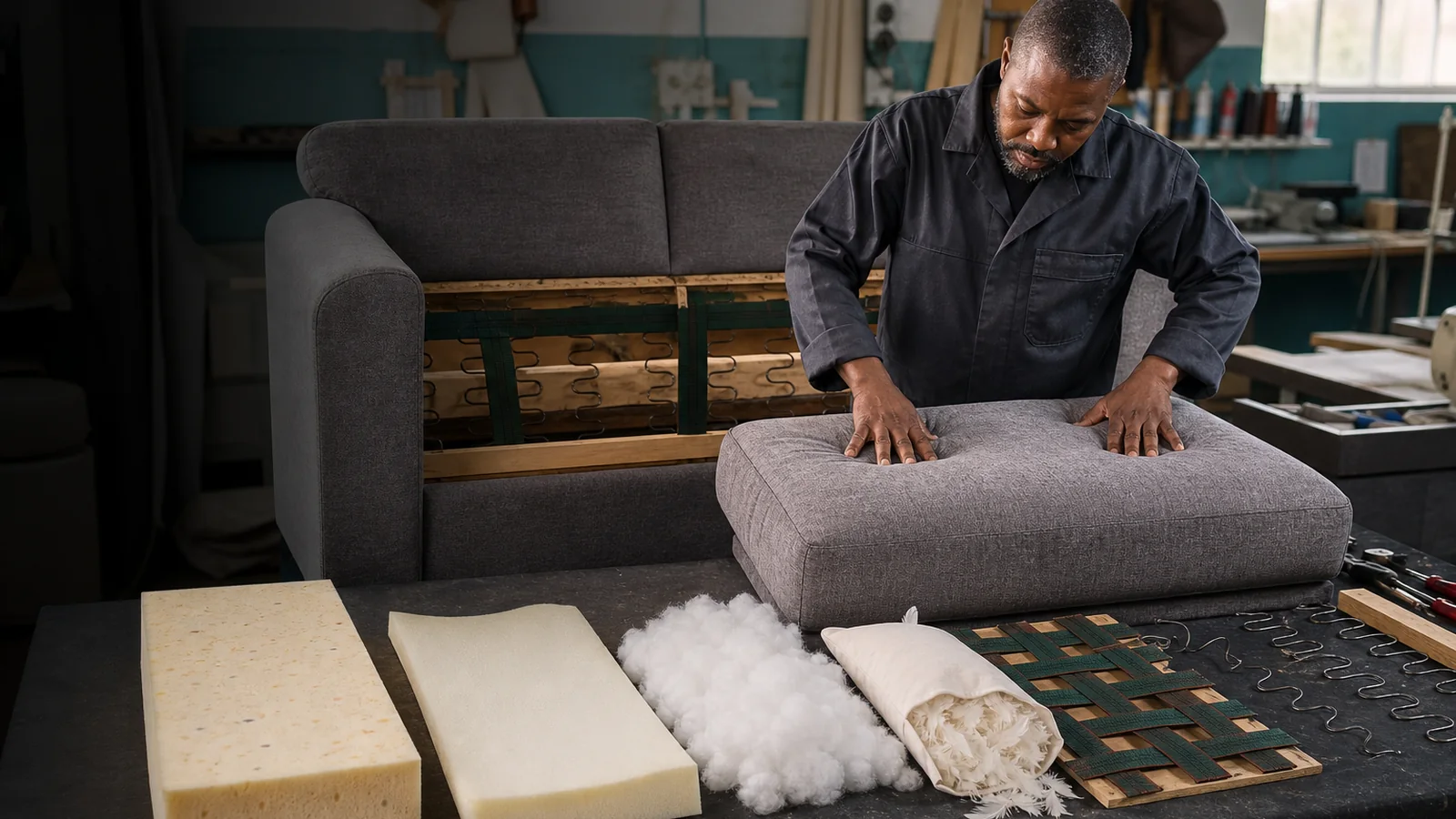
A sagging couch does not automatically need replacing. If the fabric and design still look good, the problem may be in the cushions, support system or internal frame. From Pretoria, we assess these problems for customers in Johannesburg and across Gauteng.
Start by checking removable cushions
Press each cushion firmly using your hands and fingers. Check how deeply it compresses, whether it returns to its original shape and whether it remains deformed. Compare every cushion. If one feels much softer, the problem may be localised.
Fixed cushions cannot be assessed as easily without opening the couch. Sit in different positions and compare the seats. Is the whole couch uniformly saggy, or is one section trying to introduce you to the floor?
Feather and fibre-fill cushions also lose their shape
Not every sagging cushion is made from solid foam. Some cushions are filled with feathers or fibre fill, especially back cushions and scatter cushions. These fillings feel soft and comfortable, but they compress with regular use and gradually lose their full shape.
Feather-filled cushions should be plumped and turned regularly to redistribute the filling. Fibre-fill cushions also benefit from regular plumping, but over time the fibres may become flattened or clump together. When normal plumping no longer restores the cushion, it may need to be opened and professionally restuffed.
Restuffing can bring back the shape and comfort without replacing the complete cushion cover. The amount and type of filling should still suit the cushion design, because adding too much can make it look swollen while adding too little leaves it looking tired before anyone has even sat down.
The foam may need replacing or strengthening
Foam comes in different densities. High-density polyurethane or PU foam is supportive and durable but may feel firm. Low- to medium-density foam feels softer but may not last as long. A layered construction can combine firm support with a softer comfort surface.
Memory foam: comfort developed for space
Memory foam is an engineering masterpiece developed by NASA during the 1960s to improve cushioning and comfort for astronauts. Today it is widely used in mattresses, pillows and premium seating.
It is a polyurethane-based foam containing compounds that make it respond to pressure and body heat. It gradually adjusts to the shape applying pressure, distributes weight more evenly and slowly returns to its original form afterwards.
Memory foam costs more, but good-quality material offers excellent comfort and durability. For couches, it can be combined with firmer supporting foam so you get body-contouring comfort without feeling as though the seat has swallowed you. Megabrand Furniture uses memory foam where it suits the couch design, comfort requirement and budget.
What about pocket-spring cushions?
Some foam cushions contain pocket springs. They can be very comfortable, but structural problems may develop. This construction is common in some Asian-imported couches, and a considerable amount of furniture sold locally is imported.
When a pocket spring moves out of position, it can cut through the material holding it in place like a thorn. Once this happens, the complete foam unit may need replacement because repair is often impractical. Finding exactly the same replacement size can also be difficult.
The problem may be underneath the cushions
Perfectly usable foam can still sag when the support below it fails. Possible causes include:
- A spring detached from the wooden frame
- Broken or stretched webbing
- Webbing that has lost its tension and elasticity
- A cracked internal frame
- A loose or broken wooden joint
- Damaged seat-support material
Webbing needs enough tensile strength and elasticity to create support and bounce. Once it stretches or breaks, even a new cushion may still sag.
Can a sagging couch be repaired?
In many cases, yes. The solution may involve new foam, an added comfort layer, cushion filling, spring repair, webbing replacement, frame reinforcement or joint repair.
Let us assess the sagging section
Send photos of the full couch, loose cushions and the area that sinks. Tell us whether the problem affects one seat or the complete couch.
Request a Repair Quote